Technology has become a central part of how modern organizations communicate, serve customers, manage employees, process information, protect sensitive data, and plan for growth.
However, many organizations purchase technology one product at a time without creating a clear strategy connecting business devices, software licensing, collaboration platforms, infrastructure, cybersecurity, automation, and technical support.
This fragmented approach can lead to incompatible systems, unnecessary costs, security gaps, duplicated subscriptions, difficult maintenance, and technology that does not adequately support the organization’s objectives.
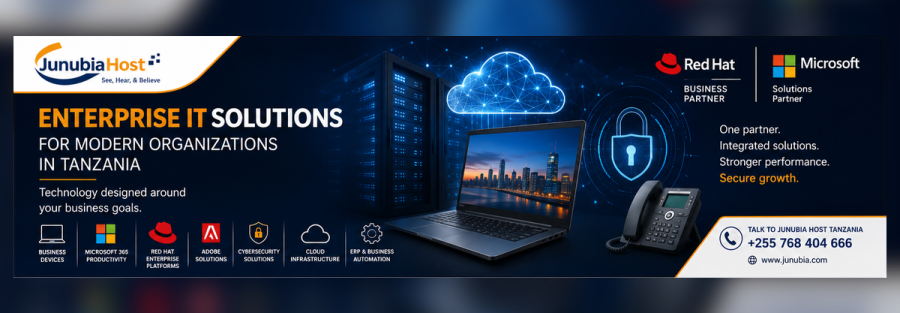
Junubia Host helps organizations in Tanzania select, implement, and manage enterprise technology solutions according to their operational requirements, workforce, budget, security priorities, and long-term plans.
As an ICT and digital-transformation provider serving organizations across East Africa, Junubia Host supports businesses, government institutions, financial organizations, NGOs, energy companies, and growing enterprises with solutions designed to improve productivity, security, and infrastructure reliability.
What Are Enterprise IT Solutions?
Enterprise IT solutions are technologies designed to support the wider operations of an organization rather than the needs of only one employee or department.
They may include:
- Business laptops and workplace devices
- Productivity and collaboration platforms
- Enterprise operating systems
- Application platforms
- IT automation
- Cybersecurity technologies
- Cloud infrastructure
- Creative and document-management tools
- ERP and business-process automation
- Network and communication systems
- Implementation, training, and support services
An effective enterprise solution should not be selected only because it is popular or available.
It should be selected because it addresses a defined business need, integrates with the organization’s current environment, can be managed securely, and supports future growth.
The Risks of Disconnected Technology Purchasing
Organizations often encounter problems when departments purchase software, devices, and systems independently.
For example, one team may use personal software subscriptions while another uses business licenses. Different departments may buy incompatible devices, store information in unrelated systems, or rely on manual processes that cannot be monitored centrally.
This can create several challenges.
Unnecessary costs
The organization may pay for overlapping systems or purchase products that do not match employee requirements.
Weak security
Devices and applications that are not centrally configured may lack approved access controls, updates, security policies, and management standards.
Difficult support
An IT team may struggle to support many unrelated products, configurations, and license types.
Poor integration
Information may need to be copied manually between departments because systems do not communicate properly.
Limited visibility
Management may not have a clear understanding of technology costs, license ownership, device status, risks, or system performance.
A structured enterprise-technology approach helps reduce these problems by aligning technical decisions with organizational objectives.
1. Business Devices and Modern Workplace Solutions
Employees require reliable devices that match their responsibilities.
An administrative user, finance professional, manager, software developer, designer, and field employee may each require a different combination of:
- Processor performance
- Memory
- Storage
- Screen size
- Battery life
- Security features
- Portability
- Business applications
Junubia Host supports organizations with the assessment, selection, supply, and setup of business devices, including Lenovo laptops and related workplace equipment.
Our approach can include:
- Reviewing user roles and workloads
- Recommending suitable device configurations
- Preparing commercial quotations
- Coordinating device supply and delivery
- Configuring user accounts
- Installing approved business applications
- Applying essential security settings
- Preparing devices for employee deployment
Device procurement should be connected to the organization’s broader workplace strategy.
For example, laptops can be prepared for Microsoft 365 services such as Outlook, Teams, OneDrive, SharePoint, and other business-productivity tools. Microsoft positions its business plans around productivity, communication, collaboration, device management, and security capabilities for organizations.
2. Microsoft 365 and Business Collaboration
Modern organizations need more than email.
Employees need secure and organized ways to communicate, conduct meetings, share documents, collaborate on projects, and access information from approved devices.
A properly planned Microsoft 365 environment can support:
- Professional business email
- Online meetings and internal communication
- Document creation and collaboration
- Centralized file access
- Departmental workspaces
- User and license administration
- Device and security policies
- Remote and hybrid working
Junubia Host can support organizations with product selection, license planning, user setup, migration preparation, configuration, and adoption guidance.
The objective is not only to activate subscriptions. It is to ensure that the platform is configured around the organization’s structure, users, data, and working practices.
3. Red Hat Enterprise Platforms
Organizations operating critical applications and infrastructure may require supported enterprise platforms for Linux, application modernization, automation, virtualization, and hybrid-cloud operations.
Junubia Host has announced its Red Hat partnership in Tanzania, with a focus on enterprise Linux, hybrid cloud, automation, container platforms, system modernization, and secure infrastructure transformation.
Relevant technologies include:
Red Hat Enterprise Linux
A supported enterprise operating-system foundation for servers, applications, and critical workloads.
Red Hat OpenShift
An enterprise application platform that supports organizations building, modernizing, deploying, and managing applications.
Red Hat Ansible Automation Platform
A platform for automating and managing IT processes across operating systems, networks, datacentres, cloud environments, and edge infrastructure.
OpenShift Virtualization
A modernization option for organizations seeking to manage virtual machines alongside containerized applications.
Junubia Host can help Tanzanian organizations assess requirements, select suitable subscriptions, prepare quotations, identify training needs, and plan implementation.
4. Adobe Creative and Document Solutions
Communication, marketing, design, reporting, and document management are important in almost every organization.
Adobe business solutions can support:
- Graphic design
- Photography and image editing
- Video production
- Marketing content
- Corporate communication
- PDF creation and editing
- Document review
- Electronic signatures
- Team license management
Adobe Creative Cloud for teams provides business-focused creative applications, services, collaboration capabilities, and centralized license administration.
Junubia Host can help organizations identify suitable Adobe products, compare individual and team requirements, obtain commercial quotations, activate licenses, and organize users.
This is valuable for marketing departments, media organizations, NGOs, universities, government communication teams, design agencies, and companies managing high volumes of professional documents.
5. Cybersecurity Solutions
As organizations become more digital, their exposure to cyber risks also increases.
Threats may involve:
- Phishing emails
- Stolen passwords
- Malware
- Unauthorized access
- Unmanaged devices
- Weak user permissions
- Vulnerable applications
- Fraudulent websites or accounts
- Inadequate monitoring
- Poor security awareness
Cybersecurity should not be treated as a single product.
It requires a combination of technology, policies, secure configuration, staff awareness, monitoring, incident planning, and regular review.
Junubia Host can support organizations in areas such as:
- Security requirement assessment
- Endpoint-security planning
- Email-security recommendations
- Identity and access controls
- Network-security solutions
- Security-awareness guidance
- Infrastructure-security review
- Product sourcing and implementation coordination
The appropriate solution depends on the organization’s systems, users, regulatory responsibilities, risk level, and operational environment.
6. Cloud Infrastructure and Digital Transformation
Cloud technologies can give organizations greater flexibility in how they deploy applications, operate infrastructure, and provide digital services.
However, moving to the cloud should not begin with purchasing resources.
It should begin with questions such as:
- Which workloads are suitable for cloud deployment?
- What data must remain under specific controls?
- What performance and availability are required?
- How will costs be managed?
- Who will administer the environment?
- What security policies must be implemented?
- How will existing systems integrate with the new environment?
Junubia Host supports organizations evaluating cloud services and hybrid environments from providers and platforms included in its wider ICT portfolio. Its website identifies services and technologies involving Microsoft Azure, Oracle, AWS, Google Cloud, Red Hat, cybersecurity, and enterprise applications.
Cloud adoption should be planned around measurable business outcomes rather than treated as a trend.
7. ERP and Business Automation
Many organizations still depend on spreadsheets, paper approvals, disconnected applications, and repeated manual data entry.
These processes can make it difficult to obtain timely information, enforce approvals, monitor budgets, manage procurement, or produce reliable reports.
ERP and automation solutions can connect areas such as:
- Finance
- Procurement
- Human resources
- Projects
- Inventory
- Approvals
- Reporting
- Asset management
- Customer operations
Junubia Host’s Oracle portfolio includes enterprise applications, ERP, HCM, databases, and cloud-infrastructure solutions for organizations seeking to improve operations and data management.
A successful ERP project requires more than software.
It requires process review, clear requirements, management support, data preparation, user involvement, implementation governance, training, and change management.
8. Communication, Networking, and Meeting Solutions
Reliable communication and network infrastructure support daily operations across offices, branches, meeting rooms, and remote teams.
Organizations may require:
- Enterprise networking
- Secure Wi-Fi
- Branch connectivity
- IP phones
- Video-conferencing systems
- Meeting-room technology
- Headsets and collaboration devices
- Centralized device management
Junubia Host provides communication and collaboration solutions for organizations in Tanzania, including consultation, product sourcing, deployment assistance, training, and after-sales coordination.
The correct solution should be selected according to the number of users, office layout, branch structure, network environment, meeting requirements, and support capacity.
Why Work with One Enterprise Technology Partner?
Working with one capable technology partner can help an organization coordinate different parts of its digital environment.
Instead of engaging unrelated suppliers for every product, the organization can receive structured support covering:
- Business and technical requirements
- Product and licensing selection
- Commercial quotations
- Procurement coordination
- Implementation planning
- Configuration and deployment
- User training
- Support coordination
- Future expansion
This approach can improve accountability and help ensure that technologies are selected as part of a connected strategy.
Industries We Support in Tanzania
Junubia Host’s enterprise solutions are suitable for organizations including:
- Banks and financial institutions
- Government ministries and agencies
- Telecom companies
- NGOs and development organizations
- Oil, gas, and energy companies
- Universities and schools
- Hospitals and healthcare organizations
- Media and communication companies
- Law firms
- Fintech companies
- Hotels and hospitality businesses
- SMEs and growing private companies
Each sector has different operational, regulatory, security, and technology requirements.
Our role is to understand those requirements before recommending a solution.
Our Enterprise Engagement Process
Step 1: Initial consultation
We discuss the organization’s objectives, current challenges, users, systems, and priorities.
Step 2: Requirement assessment
We review technical needs, workloads, licenses, infrastructure, security considerations, and budget expectations.
Step 3: Solution recommendation
We identify suitable products, configurations, subscriptions, and implementation options.
Step 4: Commercial proposal
We prepare a structured quotation or proposal explaining the recommended solution and scope.
Step 5: Supply and implementation
We coordinate procurement, configuration, deployment, and activation according to the agreed scope.
Step 6: Training and adoption
Where required, users and administrators receive guidance to help them use and manage the solution.
Step 7: Ongoing coordination
We support future licensing, expansion, vendor engagement, and technical requirements.
Conclusion
Technology delivers the greatest value when devices, software, infrastructure, security, automation, and business processes work together.
Organizations should therefore avoid purchasing technology without first understanding how it supports their employees, operations, customers, and future plans.
Junubia Host helps organizations in Tanzania create a structured approach to enterprise technology—from initial assessment and product selection to supply, licensing, deployment, and support coordination.