Business Documents Should Support Productivity, Not Slow It Down
Every organisation depends on documents.
Contracts, quotations, reports, invoices, policies, application forms, procurement documents, employee records and customer agreements move between employees, managers, customers and external partners every day.
However, many organisations still rely on inefficient processes such as:
- Printing documents only to sign and scan them again
- Recreating an entire file because one paragraph must be corrected
- Sending several versions of the same document by email
- Using separate applications for editing, conversion and signatures
- Sharing confidential documents without proper protection
- Manually checking two versions of a contract
- Purchasing unrelated licences for different employees
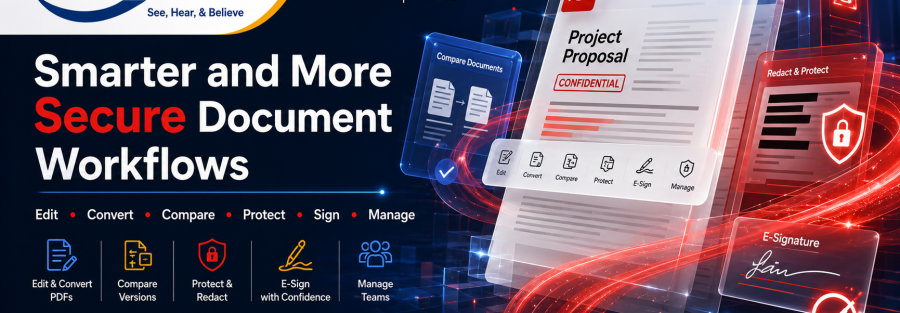
Adobe Acrobat Pro for teams provides advanced PDF and electronic-signature tools alongside centralised licence administration. Adobe describes it as an all-in-one solution for creating, editing, converting, protecting, sharing and signing business documents.
Junubia Host helps Tanzanian organisations assess their document requirements, select appropriate Adobe plans, organise users and deploy genuine Adobe business licences.
What Is Adobe Acrobat Pro for Teams?
Adobe Acrobat Pro for teams is a company-managed PDF and electronic-signature solution designed for organisations that need advanced document tools and central licence administration.
It can help employees:
- Create PDFs
- Edit text and images
- Convert Microsoft Office documents and images
- Combine several files into one PDF
- Organise and delete pages
- Protect documents with passwords
- Compare different document versions
- Convert scanned documents into searchable and editable files
- Redact confidential information
- Prepare fillable forms
- Request and track electronic signatures
- Share documents for review and comments
Adobe’s current business-plan information lists these capabilities within Acrobat Pro for teams, together with Admin Console licence management, business support and company ownership of eligible assets.
1. Edit Existing PDF Documents
Organisations often receive PDF documents that require small corrections.
A contract may contain an incorrect date. A proposal may require a new price. A report may need an updated paragraph, image or contact detail.
Without the correct PDF tools, employees may have to locate the original Word document, recreate the file or use unreliable online services.
Acrobat Pro allows authorised users to edit text and images directly within PDF documents. It can also organise pages, merge different file types and convert documents between supported formats.
This can be useful when preparing:
- Quotations
- Tender submissions
- Policies
- Project reports
- Company profiles
- Agreements
- Training materials
- Financial documents
- Marketing publications
2. Convert Documents into Professional PDFs
Business documents may begin as Word files, Excel worksheets, PowerPoint presentations, scanned pages or images.
Acrobat can convert supported documents and images into PDF format and export PDFs into other working formats where required. It can also combine different documents into one organised package.
For example, a procurement team can combine:
- A cover letter
- A technical proposal
- A commercial quotation
- Company certificates
- Product datasheets
- Supporting documents
The complete submission can then be shared as one structured PDF rather than several unrelated attachments.
3. Turn Scanned Documents into Searchable Files
Many organisations have years of information stored as scanned documents.
These may include:
- Personnel files
- Agreements
- Historical reports
- Application forms
- Customer records
- Project documents
- Official correspondence
- Financial records
Acrobat Pro can use optical character recognition to convert scanned documents into searchable and editable PDFs.
Instead of reading every scanned page manually, employees can search for a name, reference number, date or keyword within the document.
This can save time for administrative, legal, finance and records-management teams.
4. Compare Two Versions of a Document
Reviewing contracts, policies and proposals can become difficult when several versions exist.
Employees may need to determine:
- Which clauses were added
- Which figures changed
- Which paragraphs were deleted
- Whether a date or obligation was modified
- Which document represents the final approved version
Acrobat Pro includes document-comparison tools that can identify differences between two PDF versions.
This can be valuable for:
- Legal teams
- Procurement departments
- Management
- Human resources
- Project teams
- Financial institutions
- Government organisations
- Contract administrators
5. Protect Confidential Business Information
PDF documents may contain sensitive information such as:
- Customer records
- National identification details
- Financial information
- Employee data
- Contract values
- Internal decisions
- Signatures
- Bank-account details
- Confidential project information
Acrobat provides tools for password protection, access control and document security. Acrobat Pro can also permanently redact selected confidential information from a document before it is shared.
Redaction is different from covering text with a black shape. Proper redaction removes the selected information from the document rather than merely hiding it visually.
Organisations should still apply internal policies covering document classification, access approval and secure distribution.
6. Collect Electronic Signatures
Printing, signing, scanning and returning a document can delay approvals.
Acrobat business plans provide electronic-signature capabilities for sharing agreements, requesting signatures and tracking responses. Available features vary according to the selected Adobe plan and organisational requirements.
Electronic signatures may support workflows such as:
- Customer agreements
- Employee forms
- Internal approvals
- Supplier documents
- Procurement confirmations
- Service agreements
- Policy acknowledgements
- Project approvals
Electronic-signature adoption should always follow the organisation’s legal, regulatory and internal approval requirements.
7. Review and Approve Documents Collaboratively
Emailing separate document attachments often creates several uncontrolled versions.
Acrobat allows teams to share PDFs for review, commenting and approval. Stakeholders can provide feedback without repeatedly creating and sending new copies of the document.
A communications team, for example, can share an annual report with management and receive comments in one review process.
This helps reduce files named:
- Final
- Final Updated
- Final Corrected
- Final Approved
- Final Approved Version 2
8. Integrate Acrobat with Existing Workplace Applications
Acrobat can integrate with widely used workplace services, including Microsoft and Google applications and supported cloud-storage platforms. Users can perform many PDF and signature activities without continuously moving between unrelated systems.
For organisations already using Microsoft 365, this can help employees work with PDFs alongside their existing communication and productivity environment.
The exact integrations and available functions depend on the organisation’s Adobe and Microsoft subscriptions and configuration.
9. Manage Licences Centrally
Individual employee-owned subscriptions can make business licence management difficult.
The organisation may not know:
- Who owns each account
- Which employee has each licence
- How many licences are available
- Whether a licence can be reassigned
- When subscriptions will renew
- What happens when an employee leaves
Adobe Acrobat for teams provides central licence management through the Adobe Admin Console. Administrators can add, remove, move, reassign and track licences from one organisational dashboard.
This supports more organised employee onboarding and offboarding.
When an employee joins
The administrator can:
- Create or identify the approved user
- Assign the appropriate Acrobat licence
- Provide installation and access instructions
- Confirm the employee’s document responsibilities
- Apply relevant company policies
When an employee leaves
The administrator can:
- Remove access
- Reassign the licence
- Review company documents and assets
- Avoid purchasing another unnecessary licence
- Maintain organisational control
10. Protect Company Documents and Assets
Business documents should remain under organisational control when employees or projects change.
Adobe’s business plans include company ownership and asset-management capabilities designed to help organisations retain relevant documents and assets after a user leaves.
This is important for organisations managing:
- Contracts
- Branded templates
- Legal documents
- Reports
- Corporate forms
- Marketing materials
- Approved company publications
- Shared document libraries
Acrobat Standard or Acrobat Pro?
Adobe currently offers different Acrobat business plans.
Acrobat Standard for teams
Generally suitable for common PDF activities such as:
- Creating PDFs
- Editing and converting documents
- Organising pages
- Collecting electronic signatures
- Password protection
- Central licence administration
Acrobat Pro for teams
Adds advanced document capabilities such as:
- Comparing PDF versions
- Redacting confidential information
- Converting scanned documents into editable PDFs
- Creating web forms
- Advanced accessibility and compliance tools
- Additional professional PDF functions
Adobe’s current business comparison identifies Acrobat Pro as the advanced PDF and electronic-signature option, while Acrobat Standard focuses on essential PDF workflows.
The correct plan should be selected according to each employee’s responsibilities rather than purchasing the same licence automatically for everyone.
Organisations That Can Benefit
Adobe Acrobat Pro for teams can support:
- Banks and financial institutions
- Government ministries and agencies
- NGOs and development organisations
- Law firms
- Universities and schools
- Healthcare organisations
- Engineering and construction companies
- Oil and energy companies
- Hotels
- Telecom organisations
- Media companies
- Professional-service firms
- SMEs
- Corporate finance and procurement departments
The most appropriate plan depends on the organisation’s document volume, security requirements, signature processes and administrative structure.
How Junubia Host Supports Tanzanian Organisations
Requirement assessment
We review your departments, users, PDF activities, signature requirements and document-security priorities.
Product selection
We help determine whether users require Acrobat Standard for teams, Acrobat Pro for teams or another suitable Adobe business plan.
Licence quotation
We prepare a commercial quotation based on the approved product, number of users and subscription period.
Administrator and user planning
We help identify the Adobe administrator, approved users and licence-assignment responsibilities.
Licence deployment
We support licence assignment, installation planning and initial user access.
Workflow guidance
We help teams understand how Acrobat can support editing, conversion, review, protection, signatures and document administration.
Renewal coordination
We help organisations plan renewals and future user requirements.
Conclusion
PDF documents are part of almost every important organisational process.
When document creation, editing, approval, protection and signature activities are disconnected, employees lose time and organisations face greater operational risk.
Adobe Acrobat Pro for teams provides advanced document tools together with central licence management and company-controlled administration.
Junubia Host helps organisations in Tanzania select, license and deploy genuine Adobe Acrobat solutions that match their real business requirements.