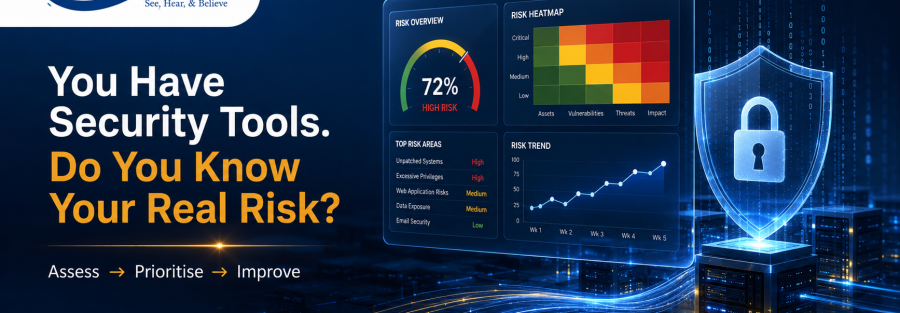
Your organization may already have firewalls, Microsoft 365, endpoint protection, and other security technologies.
But can you answer confidently?
- What are our most important systems and data?
- Which accounts have excessive privileges?
- Are our endpoints properly protected?
- Are critical vulnerabilities still open?
- Is our network appropriately segmented?
- Are cloud applications configured securely?
- Would employees recognize a phishing attempt?
- Who responds when a security alert appears?
If the answer to several of these questions is unclear, the organization may have cybersecurity risks that have never been properly assessed.
What Should a Cybersecurity Assessment Review?
A practical assessment should examine the areas that matter most:
Identity and access. MFA, administrator accounts, user permissions, and employee access.
Endpoints: laptops, desktops, servers, endpoint protection, and device security.
Network security includes firewalls, segmentation, remote access, and unnecessary exposure.
Email and Microsoft 365 phishing protection, authentication, and security configuration.
Cloud & Applications
SaaS applications, cloud workloads and access controls.
Vulnerabilities and misconfigurations, patch gaps, unsupported systems, and insecure settings.
Data Protection
How sensitive information is stored, accessed and shared.
Monitoring & Response
Security alerts, escalation procedures and incident readiness.
NIST CSF 2.0 allows organizations to compare their current cybersecurity posture with a desired target state and use the gap to prioritize improvement.
The Junubia Host Approach
Assess → Identify Gaps → Prioritize Risk → Recommend → Improve
The goal is not to sell unnecessary technology.
The goal is to identify:
What is most exposed, what matters most to the business, and what should be fixed first.