
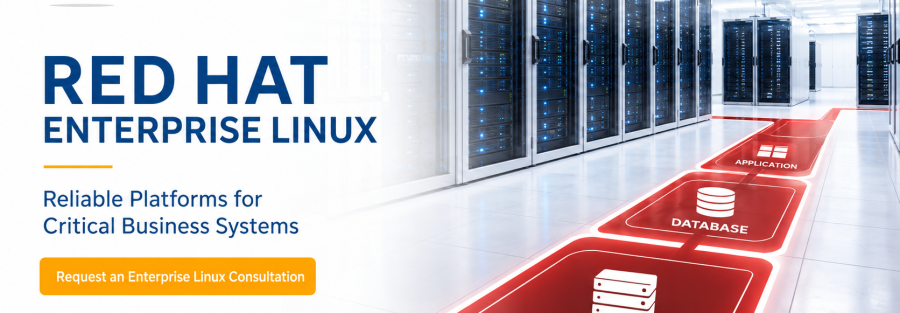
Government ministries and agencies in South Sudan increasingly run important systems on Linux servers: payroll, revenue collection, registration databases, websites and email gateways. Linux is reliable and efficient, and many free versions are available. But “free” often means “unsupported”. When a critical system fails late at night, or a serious security flaw is announced, an unsupported server leaves your team on its own.
This article explains what Red Hat Enterprise Linux (RHEL) adds, when it is worth paying for, and how to move existing systems to it.
The Hidden Cost of Unsupported Linux
- Security patches may stop when a free distribution reaches end of life
- No vendor to call when the system will not boot or a database corrupts
- Software vendors may refuse to support their application on an uncertified operating system
- Knowledge sits with one or two people, and leaves when they leave
- Auditors ask who is responsible, and there is no clear answer
What Red Hat Enterprise Linux Adds
A long, predictable life cycle
Each major RHEL version receives security updates and fixes for many years. You can plan upgrades around budgets and projects instead of being forced to rebuild servers at short notice.
Access to Red Hat support
A subscription includes access to Red Hat’s support and knowledge base. Your local partner handles first-line support and escalates to Red Hat when needed, so there is always someone accountable.
Certified for business software
Many database, ERP and security vendors certify their products on RHEL. Running a certified platform means the application vendor will support you too.
Tools that save administrator time
RHEL includes tools for managing updates across many servers and for checking systems against security baselines. Ansible automation, available with Red Hat, lets a small team manage many servers consistently.
Which Systems Need It Most
You do not have to move every server at once. Start with the systems where an outage or data breach would hurt most:
- Databases holding citizen, staff or financial records
- Payroll and revenue systems
- Public-facing websites and portals
- Servers running vendor applications that require a certified OS
Moving Existing Systems to RHEL
Make an inventory
List every Linux server, the distribution and version it runs, what it does and who owns it. Mark those at or near end of life.
Choose convert or rebuild
Some compatible distributions can be converted to RHEL in place with Red Hat’s tools. Older or heavily customised servers are usually better rebuilt fresh and the application moved across.
Test, back up, then switch
Take a full backup, test the move on a copy where possible, and plan the switch for a quiet period with a clear way back.
Quick Checklist
- Inventory of all Linux servers and their end-of-life dates
- Critical systems identified for supported subscriptions
- Backups tested before any migration
- Update and patch schedule agreed
- A local partner responsible for first-line support
How Junubia Host Can Help
Junubia Host supplies Red Hat subscriptions and helps government offices plan and carry out migrations, from our head office in Juba. We can also supply the servers and backup to go with it. See our IT solutions in South Sudan.
Talk to Our Juba Team
Book a free IT assessment to review your servers and licences. WhatsApp: +211 924 786 666 (South Sudan) or +255 768 404 666 (Tanzania and Rwanda).
Written by Dut Majak, CEO and Founder of Junubia Host Co Ltd. Dut leads Junubia’s work with banks, government institutions, NGOs and businesses across South Sudan, Tanzania and Rwanda.