Moving to Microsoft 365 Requires More Than Buying Licenses
Microsoft 365 can provide professional email, productivity applications, online meetings, document collaboration, user administration, and business-security capabilities.
However, activating subscriptions without a clear implementation plan can create confusion for employees and administrators.
Organizations must decide:
- Which Microsoft 365 plan each employee requires
- How users and email addresses will be structured
- Which data must be migrated
- How existing mailboxes will be moved
- Which departments need Microsoft Teams
- How OneDrive and SharePoint will be organized
- Which security settings should be applied
- How employees will be trained
- Who will administer the environment after implementation
Microsoft’s setup guidance covers connecting an existing business domain, creating users, assigning licenses, configuring email, setting up services, and moving existing email, calendars, and contacts.
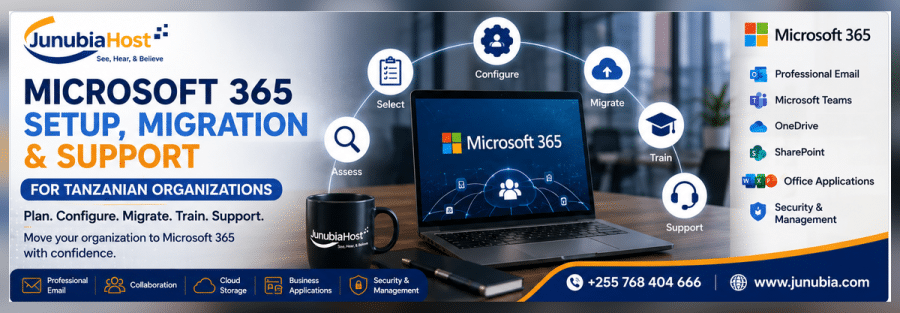
Junubia Host helps Tanzanian organizations manage this process from assessment and licensing through configuration, migration, employee onboarding, and ongoing support.
Why Microsoft 365 Projects Need Proper Planning
A poorly planned migration can affect business communication and daily operations.
Potential problems include:
- Employees being unable to access email
- Important historical messages being omitted
- Incorrect email addresses
- Duplicate or missing user accounts
- Insufficient licenses
- Unclear administrator responsibilities
- Employees storing documents in the wrong location
- Teams and SharePoint environments becoming disorganized
- Weak access controls
- Limited user adoption
The purpose of planning is to understand the organization’s existing environment before making changes.
A Microsoft 365 migration plan should identify:
- Existing users and mailboxes
- Current email and collaboration platforms
- Required Microsoft 365 licenses
- Data to be moved
- Users included in the first migration phase
- Migration method
- Security and access requirements
- Employee communication and training
- Testing and acceptance procedures
- Post-migration support arrangements
1. Assess the Existing Technology Environment
The first step is to understand how the organization currently works.
The assessment should review:
- Number of employees
- Existing email provider
- Current email addresses
- Mailbox sizes
- Calendars and contacts
- Shared mailboxes
- Departmental addresses
- Distribution groups
- Existing documents and shared drives
- Employee devices
- Installed Microsoft applications
- Current security controls
- Branch and remote-work requirements
- Internet and network capacity
- Internal technical skills
This information helps determine the correct licensing, migration method, project timeline, and support requirements.
A ten-user organization moving from basic hosted email will require a different approach from a large institution operating on-premises Exchange, multiple branches, and shared departmental systems.
2. Select the Correct Microsoft 365 Plans
Not every employee necessarily needs the same subscription.
Users should be grouped according to their responsibilities and application requirements.
Employees who mainly require email and web applications
These employees may need:
- Professional email
- Browser-based Word, Excel, and PowerPoint
- OneDrive
- Online meetings and collaboration
Employees who need desktop applications
These users may require installed versions of:
- Microsoft Word
- Microsoft Excel
- Microsoft PowerPoint
- Microsoft Outlook
- Other eligible Microsoft applications
Employees requiring stronger management and security
Organizations may require eligible plans that support:
- Device management
- Identity and access policies
- Endpoint protection
- Threat protection
- Application controls
- Additional security administration
The correct selection should consider employee roles, applications, devices, mobility, security requirements, and budget.
3. Prepare the Microsoft 365 Environment
The Microsoft 365 environment should be configured around the organization’s identity and administrative structure.
Initial preparation may include:
- Creating or confirming the Microsoft 365 tenant
- Connecting the organization’s existing business domain
- Creating administrator accounts
- Assigning administrative roles
- Establishing user-naming standards
- Preparing security defaults or agreed policies
- Reviewing service settings
- Confirming license availability
Microsoft explains that the person who initially signs up becomes the technical administrator, while additional administrators can later be assigned specific roles. Its setup process also covers connecting an existing domain and adding the required DNS records.
Administrative access should be limited to authorized personnel. The organization should avoid allowing every technical employee to operate with the highest level of administrator permissions.
4. Create Users and Assign Licenses
Each employee requires an approved account before services can be configured.
The user-creation process may include:
- Employee’s full name
- Approved username
- Professional email address
- Department
- Job role
- Office location
- Microsoft 365 license
- Administrative role, where required
- Group and team membership
- Security requirements
Microsoft 365 administrators can add and remove users, assign licenses, reset passwords, manage groups, configure email services, and monitor subscriptions through the Microsoft 365 admin centre.
A standard naming format should be agreed before users are created.
Examples include:
firstname.lastname@company.co.tzfirstname@company.co.tz- Departmental addresses such as
finance@company.co.tz
Using one consistent structure improves administration and professional communication.
5. Choose the Correct Email-Migration Method
Microsoft supports different migration approaches depending on the organization’s current email system.
Possible sources may include:
- On-premises Microsoft Exchange
- Another Microsoft 365 tenant
- Google Workspace
- Gmail
- IMAP-compatible hosted email
- Outlook PST files
- Other supported messaging systems
Microsoft’s official guidance describes migration options for Exchange environments, IMAP-enabled systems, PST imports, user-managed imports, and migrations completed with assistance from a Microsoft partner.
The correct migration method depends on:
- Existing email platform
- Number of mailboxes
- Mailbox sizes
- Data types
- Available administrative access
- Acceptable downtime
- Required coexistence period
- Project timeline
The organization should not select a migration method until the current environment has been assessed.
6. Prepare and Clean the Data
Migrating unnecessary or outdated information can increase complexity.
Before migration, organizations should consider reviewing:
- Inactive employee accounts
- Duplicate mailboxes
- Old distribution groups
- Unused departmental addresses
- Unnecessary folders
- Oversized attachments
- Obsolete documents
- Unapproved personal data
- Accounts with unclear ownership
The organization should also decide what must be retained according to its internal policies, regulatory obligations, and operational requirements.
A migration is an opportunity to improve the environment rather than copying every existing problem into the new platform.
7. Conduct a Pilot Migration
A pilot allows the organization to test the configuration and migration process before moving all employees.
The pilot group may include:
- IT or technical employees
- One representative from each major department
- Employees who understand existing business processes
- Users who can provide structured feedback
The pilot should test:
- User sign-in
- Email sending and receiving
- Historical mailbox data
- Calendars and contacts
- Outlook configuration
- Mobile access
- Teams meetings and chat
- OneDrive synchronization
- SharePoint access
- Security policies
- Employee instructions
Microsoft recommends starting Teams, OneDrive, and SharePoint deployments with pilot users, collecting feedback, resolving issues, and expanding the rollout when the initial group can successfully perform the required tasks.
8. Migrate Email, Calendars, and Contacts
Once the pilot is approved, migration can move to the agreed production phase.
Depending on the source and method, the migration may include:
- Email messages
- Folder structures
- Calendars
- Contacts
- Mailbox permissions
- Shared mailboxes
- Distribution groups
- Selected archives
Microsoft’s migration guidance recommends reviewing platform limits and best practices before starting, because the available methods and expected behaviour vary according to the source system.
The migration plan should identify:
- Start time
- Expected completion time
- Responsible technical team
- User groups included
- Communication to employees
- Escalation procedures
- Validation steps
- Contingency arrangements
9. Configure Outlook and Employee Devices
After the mailbox is ready, employees need access from their approved devices.
Configuration may include:
- Microsoft Outlook
- Microsoft 365 applications
- Mobile email
- Microsoft Teams
- OneDrive synchronization
- SharePoint access
- Browser sign-in
- Security and authentication
- Approved device policies
The organization should test sending and receiving messages internally and externally.
Employees should also confirm access to:
- Calendars
- Contacts
- Shared mailboxes
- Department groups
- Required applications
- Relevant Teams and SharePoint resources
10. Plan the Microsoft Teams Structure
Microsoft Teams should not be deployed without an agreed organizational structure.
Otherwise, employees may create duplicate teams, unclear channels, and unmanaged collaboration spaces.
The planning process should determine:
- Which departments need a team
- Who owns each team
- Who can create new teams
- Which users belong to each department
- Naming conventions
- Guest-access requirements
- Meeting policies
- File-sharing practices
- Lifecycle and archiving responsibilities
Microsoft’s current deployment guidance recommends rolling Teams out in stages, beginning with core workloads such as chat, teams, channels, and applications, then expanding to meetings and other capabilities according to organizational readiness.
11. Organize OneDrive and SharePoint
OneDrive and SharePoint serve different but connected purposes.
OneDrive
Generally used for an employee’s individual business files and controlled sharing.
SharePoint
Generally used for:
- Departmental documents
- Project resources
- Policies and procedures
- Team information
- Shared organizational content
- Internal sites
Before rollout, the organization should define:
- Which information belongs in OneDrive
- Which information belongs in SharePoint
- Who can access each site
- External-sharing rules
- Department owners
- Document-retention requirements
- File-synchronization policies
Microsoft recommends assessing business requirements, sharing options, compliance needs, migration plans, network effects, training, and change management before broad OneDrive and SharePoint deployment.
12. Configure Security and Administrative Controls
Microsoft 365 security should be configured according to the selected plan and the organization’s risk requirements.
The implementation may include:
- Multifactor authentication
- Administrator-role separation
- Password and sign-in policies
- User-access reviews
- Device-management policies
- Endpoint protection
- Email-security controls
- External-sharing settings
- Guest-access rules
- Security alerts
- Employee-exit procedures
Security should be tested before the project is considered complete.
The organization should also identify who will:
- Create new users
- Approve licenses
- Reset passwords
- Review alerts
- Manage employee exits
- Approve external access
- Contact Junubia Host for support
13. Train Employees and Administrators
A technically successful migration can still fail when employees do not understand the new platform.
User training should cover:
- Signing in
- Using professional email
- Managing calendars
- Joining Teams meetings
- Using team channels
- Sharing documents correctly
- Using OneDrive
- Accessing SharePoint
- Protecting passwords
- Recognizing suspicious messages
- Requesting technical support
Administrators may need additional guidance on:
- Creating users
- Assigning licenses
- Resetting passwords
- Managing groups
- Reviewing services
- Handling employee exits
- Escalating technical issues
Microsoft identifies training and change management as important parts of Teams, OneDrive, and SharePoint deployment.
14. Provide Post-Migration Support
Support is especially important during the first days after go-live.
Common issues may include:
- Forgotten passwords
- Outlook-profile problems
- Mobile-device configuration
- Missing historical messages
- Incorrect mailbox permissions
- Teams-access questions
- OneDrive synchronization
- SharePoint permissions
- Application activation
- Employee uncertainty
A post-migration support period should define:
- Support contact
- Operating hours
- Priority levels
- Escalation process
- Administrator responsibilities
- Issue tracking
- Resolution targets
- End-of-project review
How Junubia Host Supports Your Microsoft 365 Project
Junubia Host can support Tanzanian organizations through the complete implementation lifecycle.
Requirement assessment
We review users, email systems, applications, data, security requirements, and business priorities.
Licensing guidance
We help match employee groups to suitable Microsoft 365 plans.
Microsoft 365 preparation
We help prepare the tenant, administrators, users, licenses, and approved settings.
Professional email setup
We configure professional email using the organization’s existing business domain.
Migration planning
We assess the source environment and identify an appropriate migration approach.
Pilot migration
We test the migration process with selected users before broader deployment.
Production migration
We coordinate mailbox and agreed data migration according to the approved plan.
Teams, OneDrive, and SharePoint setup
We help structure collaboration tools according to departments and business requirements.
Application and device configuration
We configure eligible Microsoft applications and approved user devices.
Security configuration
We assist with agreed access and security settings according to the selected plan.
Employee and administrator guidance
We provide practical orientation for users and designated administrators.
Ongoing support
We support account changes, additional licenses, troubleshooting, and future requirements.
Organizations That Can Benefit
Microsoft 365 setup and migration services can support:
- SMEs
- Banks and financial institutions
- NGOs
- Government institutions
- Schools and universities
- Hospitals and clinics
- Hotels
- Telecom companies
- Law firms
- Construction companies
- Engineering firms
- Energy companies
- Media organizations
- Professional service companies
- Growing private organizations