Build a Workplace That Connects Your People, Technology, and Business Goals
Organizations across Tanzania are changing how their employees communicate, collaborate, access information, serve customers, and complete daily responsibilities.
Employees may work from head offices, branches, project locations, customer sites, or while travelling. They need secure access to professional email, meetings, business applications, documents, and organizational resources from approved devices.
However, simply purchasing laptops and software subscriptions does not create a modern workplace.
A complete workplace requires coordinated decisions covering:
- Business devices
- Professional email
- Productivity applications
- Meetings and collaboration
- Document management
- User accounts and permissions
- Security
- Employee onboarding
- Training
- Technical support
Microsoft describes Microsoft 365 for business as a connected environment offering custom-branded email, professional applications, security capabilities, and scalable administrative controls. Its business plans can include services such as Teams, OneDrive, SharePoint, and centralized user management, depending on the selected subscription.
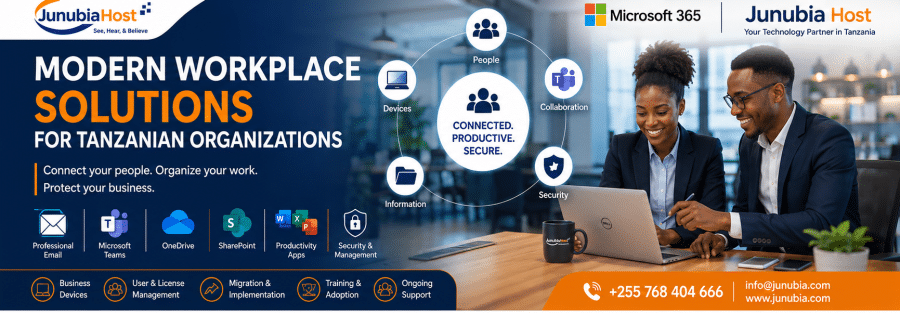
Junubia Host helps Tanzanian organizations assess, select, configure, deploy, and support modern workplace technologies according to their operational requirements. Junubia Host’s current portfolio includes Microsoft 365, Azure, Defender, enterprise applications, cybersecurity, and productivity solutions.
What Is a Modern Workplace?
A modern workplace is an organized technology environment that allows employees to communicate, collaborate, access approved information, and complete their responsibilities efficiently and securely.
It normally connects several areas.
People
Employees, managers, administrators, external collaborators, and technical teams.
Devices
Business laptops, desktops, smartphones, meeting-room equipment, and other approved workplace devices.
Applications
Email, productivity software, communication tools, business applications, and departmental systems.
Information
Documents, reports, policies, customer information, project files, and shared organizational resources.
Administration
User creation, license assignment, permissions, password management, employee onboarding, and employee-exit controls.
Security
Identity protection, device controls, email security, access policies, endpoint protection, and employee awareness.
A modern workplace should be designed around the organization’s users and processes—not around a single product.
1. Professional Business Communication
Employees should communicate through company-controlled accounts rather than unrelated personal email addresses.
A professional email structure can include:
firstname.lastname@company.co.tzsales@company.co.tzfinance@company.co.tzsupport@company.co.tz
Professional email helps create a consistent identity and gives the organization greater control over business correspondence.
Microsoft 365 business solutions can provide custom-branded email alongside professional applications and administrative controls.
Junubia Host can assist with:
- Email-account planning
- User naming conventions
- User creation
- License assignment
- Outlook configuration
- Departmental email addresses
- Migration planning
- Employee guidance
The company’s existing business domain can be connected to Microsoft 365. Domain registration itself remains outside this Junubia Host campaign.
2. Productivity Applications for Different Employee Role
Not every employee performs the same work.
A finance professional may depend heavily on Excel, while a communications officer may work primarily with Word, PowerPoint, Outlook, and collaborative documents.
A manager may require:
- Outlook
- Teams
- PowerPoint
- Calendar access
- Secure document access
- Mobile availability
A general employee may need:
- Professional email
- Browser-based applications
- OneDrive
- Teams
- Departmental files
Microsoft 365 business plans provide different combinations of web, mobile, and desktop applications. The correct subscription should therefore be selected according to each employee’s responsibilities, devices, security requirements, and working practices.
Junubia Host can help categorize employees and recommend suitable licensing profiles rather than assigning the same plan automatically to every user.
3. Microsoft Teams for Meetings and Collaboration
Email is useful for formal communication, but it is not always the best place for continuous discussions, meetings, shared work, and project coordination.
Microsoft Teams can support:
- Online meetings
- Team chat
- Audio and video communication
- Departmental channels
- File collaboration
- Project discussions
- Screen sharing
- Approved external collaboration
Microsoft’s current business-plan information shows that Teams capabilities are available through eligible plan versions and can integrate with business applications and shared files.
A structured Teams environment may include dedicated spaces for:
- Management
- Finance
- Human resources
- Sales
- Procurement
- Customer service
- Projects
- Branch offices
- Executive committees
Junubia Host can help plan team ownership, memberships, naming standards, channels, and basic working practices.
4. OneDrive and SharePoint for Business Information
Business information should not depend entirely on individual computers or repeated email attachments.
OneDrive
OneDrive can support employees’ individual business files, controlled sharing, and collaboration across supported devices.
SharePoint
SharePoint can support shared organizational information such as:
- Departmental documents
- Policies and procedures
- Project resources
- Team sites
- Internal announcements
- Shared files
- Organizational information
Microsoft’s business plans can include OneDrive for secure file storage and co-authoring, along with SharePoint team sites for sharing files, content, and organizational resources.
A successful workplace implementation should define clearly:
- What employees store in OneDrive
- What departments manage in SharePoint
- Who can access each resource
- Who owns each departmental site
- Which external-sharing rules apply
- How documents are named and organized
5. Centralized User and License Administration
Organizations need a controlled process for creating, changing, and removing user access.
Authorized administrators can use the Microsoft 365 admin centre to:
- Add users
- Assign licenses
- Remove licenses
- Manage available applications and services
- Reset passwords
- Review user status
- Manage groups
- Address licensing errors
Microsoft’s current administration guidance confirms that users require accounts and licenses before accessing Microsoft 365 services, and that authorized administrators can assign licenses and control which included services are available to users.
This supports a more structured employee lifecycle.
When an employee joins
The organization can:
- Create the account
- Assign the approved license
- Configure professional email
- Add the employee to relevant teams
- Provide access to approved documents
- Configure the employee’s device
- Provide user guidance
When an employee leaves
The organization can:
- Block access
- Recover company devices
- Preserve required information
- Remove group and team memberships
- Reassign or remove the license
- Transfer approved responsibilities
- Prepare the device for another employee
6. Business Devices That Match Employee Requirements
Employees need devices that match their workloads.
A complete device assessment should consider:
- Processor performance
- Memory
- Storage
- Display size
- Mobility
- Battery requirements
- Meeting and camera quality
- Security features
- Required business applications
- Expected working life
Junubia Host can help organizations categorize employees into suitable device profiles, such as:
General workplace users
For email, documents, web applications, meetings, and standard business systems.
Finance and advanced users
For larger spreadsheets, financial applications, reporting, and heavier multitasking.
Technical professionals
For engineering, development, analytics, or other performance-intensive work.
Managers and mobile employees
For portability, meetings, communication, and secure access across locations.
The device should then be configured with the appropriate Microsoft 365 services, approved applications, user account, permissions, and security settings.
7. Security as Part of the Workplace Design
Security should not be added only after devices and users have already been deployed.
It should be included from the beginning.
A secure workplace may require:
- Individual user identities
- Multifactor authentication
- Appropriate administrative roles
- Approved device configurations
- Email protection
- Endpoint security
- Access policies
- Controlled document sharing
- Employee-exit procedures
- Security-awareness training
Microsoft 365 Business Premium includes additional identity, device-management, email-protection, and endpoint-security capabilities, including Intune Plan 1 and Microsoft Defender services. Exact capabilities depend on the selected plan and configuration.
Security technology still needs to be configured correctly and supported by organizational policies and employee awareness.
8. Workplace Standardization
Using too many unrelated devices, software versions, configurations, and license types makes technical support more difficult.
An organization can simplify management by defining approved workplace packages.
Standard Employee Package
- Approved business laptop
- Professional email
- Microsoft Teams
- OneDrive
- Required productivity applications
- Standard security configuration
Advanced User Package
- Higher-performance business device
- Desktop productivity applications
- Departmental SharePoint access
- Advanced application requirements
- Stronger device and security controls
Manager and Mobile User Package
- Lightweight device
- Professional email and calendar
- Microsoft Teams
- Secure document access
- Mobile and remote-working configuration
Standardization can improve:
- Procurement
- Deployment
- Employee onboarding
- Troubleshooting
- Security
- License management
- Device replacement
- Support efficiency
9. Employee Training and Adoption
Technology delivers limited value when employees do not understand how to use it.
Workplace training may cover:
- Professional email practices
- Calendars and meeting invitations
- Microsoft Teams meetings
- Team channels
- OneDrive
- SharePoint
- Document sharing
- Account security
- Password protection
- Reporting suspicious messages
- Requesting support
Managers and administrators may need additional guidance on:
- User creation
- License assignment
- Access approval
- Team ownership
- Employee exits
- Security responsibilities
- Support escalation
Adoption should be treated as part of implementation—not as an optional activity after the project is completed.
10. How Junubia Host Supports Workplace Transformation
Junubia Host can support Tanzanian organizations through a structured modern-workplace process.
Step 1: Assess
We review employees, devices, applications, communication tools, files, security, and operational challenges.
Step 2: Design
We define suitable device, licensing, collaboration, security, and support profiles.
Step 3: Supply and License
We coordinate approved business devices and Microsoft 365 subscriptions.
Step 4: Configure
We prepare users, applications, professional email, collaboration tools, permissions, and security settings.
Step 5: Migrate
Where required, we plan and coordinate the movement of approved email and business information.
Step 6: Deploy
We test and assign devices and user accounts according to the approved rollout plan.
Step 7: Train
We provide practical guidance for employees and designated administrators.
Step 8: Support
We assist with user changes, license requirements, troubleshooting, and future expansion.
Organizations That Can Benefit
Modern workplace solutions can support:
- SMEs
- Banks and financial institutions
- Government institutions
- NGOs
- Schools and universities
- Healthcare organizations
- Telecom companies
- Law firms
- Hotels
- Construction companies
- Engineering firms
- Energy companies
- Media organizations
- Professional-service companies
- Growing private businesses
Every organization should adapt the workplace design to its own users, processes, risks, and regulatory responsibilities.
Conclusion
A modern workplace is not one application, one laptop, or one subscription.
It is a connected environment that helps employees communicate professionally, collaborate effectively, access approved information, and work securely.
Junubia Host helps Tanzanian organizations connect business devices, Microsoft 365, professional email, collaboration, administration, security, training, and support within one coordinated workplace strategy.