Email remains one of the most important communication tools used by modern organizations. It is used to send quotations, receive customer enquiries, share official documents, communicate with suppliers, coordinate staff, organize meetings, and maintain business relationships.
However, business communication requires more than simply creating an email account.
Organizations need a professional system that strengthens their credibility, protects business information, supports teamwork, and allows administrators to manage employees and access centrally.
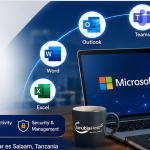
Microsoft 365 brings business email, calendars, meetings, file storage, collaboration, productivity applications, and administration together within one connected environment. Microsoft’s business services include Outlook and Exchange for business email, Teams for meetings and collaboration, OneDrive for individual business files, and SharePoint for team information and shared resources.
Junubia Host helps Tanzanian businesses and organizations select, configure, migrate to, and manage suitable Microsoft 365 solutions according to their operational requirements.
Why Personal Email Accounts Are Not Enough for Business
A personal email account may be suitable for private communication, but it can create limitations when used for official company activities.
Consider the difference between these addresses:
companyname@gmail.comsales@companyname.co.tz
The second address clearly identifies the organization and the department responsible for the communication.
When customers receive quotations, contracts, invoices, official notices, or support responses from a company-branded address, the communication appears more structured and professional.
Professional email also allows an organization to create consistent addresses for different functions, such as:
info@companyname.co.tzsales@companyname.co.tzfinance@companyname.co.tzsupport@companyname.co.tzfirstname.lastname@companyname.co.tz
Microsoft identifies professional business email as a way to build customer trust, while Exchange and Outlook provide business-class email, calendars, contact management, spam filtering, and scheduling features.
1. Build a More Professional Business Identity
Every email sent by an employee represents the organization.
A company-branded email address can help communicate that the business is established, organized, and serious about its relationships with customers and partners.
This is especially important when communicating with:
- Banks and financial institutions
- Government agencies
- Corporate customers
- International partners
- NGOs and development organizations
- Suppliers and distributors
- Job applicants
- Investors
- Professional service providers
Professional email creates consistency across departments and employees. Instead of allowing staff to communicate through unrelated personal accounts, the organization can define a clear naming structure and create controlled user accounts.
2. Keep Business Communication Under Organizational Control
One of the major risks of using personal email for business is that the account normally belongs to the individual rather than the organization.
When an employee leaves, the business may lose access to:
- Customer correspondence
- Contracts and attachments
- Supplier information
- Meeting history
- Project discussions
- Important contacts
- Operational records
With Microsoft 365, administrators can centrally create user accounts, assign or remove licenses, reset passwords, restore users, and manage other common administrative tasks.
This allows the organization to manage access according to employment responsibilities rather than depending on privately controlled accounts.
A structured employee-exit process can include:
- Blocking the former employee’s access
- Changing or resetting account credentials
- Preserving required business information
- Reassigning responsibilities
- Removing or changing the license
- Configuring appropriate email forwarding or mailbox access
- Reviewing company devices and application access
Central administration provides stronger organizational control and better continuity.
3. Manage Email, Calendars, Tasks, and Contacts Together
Professional communication is not limited to sending messages.
Employees also need to:
- Schedule meetings
- Check colleague availability
- Manage calendars
- Organize contacts
- Set reminders
- Track tasks
- Coordinate appointments
Microsoft Outlook brings email, calendars, contacts, and tasks together. Exchange provides business-class email and calendaring capabilities, including spam and malware filtering and meeting scheduling.
This can help teams reduce missed meetings, improve scheduling, and manage professional communication more consistently.
For example, a sales department can schedule customer meetings, a project team can coordinate deadlines, and management can organize recurring internal reviews through shared business calendars.
4. Bring Meetings, Chat, Calls, and Teamwork Together
Email is useful for formal communication, but it is not always the best tool for every discussion.
Long email chains can make it difficult to track decisions, identify the latest file, or understand who is responsible for the next action.
Microsoft Teams can bring chat, meetings, calls, files, and applications into a shared working environment. Microsoft describes Teams as a platform for bringing people together to meet, chat, call, and collaborate.
Organizations can use Teams to create dedicated spaces for:
- Management
- Finance
- Human resources
- Sales
- Customer service
- Procurement
- Projects
- Branch offices
- Executive committees
- Temporary working groups
Each team or channel can contain discussions, shared documents, meetings, and relevant applications.
This can reduce dependence on informal communication channels and keep important work connected to the organization’s managed environment.
5. Improve Online and Hybrid Meetings
Organizations increasingly work across different cities, branches, and countries.
A company in Dar es Salaam may have employees, customers, suppliers, or project partners in Arusha, Dodoma, Mwanza, Zanzibar, Nairobi, Kigali, Juba, or other locations.
Teams can support:
- Online meetings
- Video calls
- Audio calls
- Screen sharing
- Meeting chat
- File sharing
- Team discussions
- Webinars, depending on the selected plan
- Collaboration before and after meetings
The availability of Teams and specific features depends on the Microsoft 365 plan selected, because Microsoft currently offers business-plan options with and without Teams.
A properly configured collaboration platform can help reduce unnecessary travel and allow organizations to maintain regular communication between offices and external stakeholders.
6. Stop Sending Multiple Versions of the Same Document
A common workplace problem begins when one employee sends a document as an email attachment.
Another employee edits it and sends a new version. A third person makes additional changes and creates another copy.
Soon, the team has files named:
- Proposal Final
- Proposal Final Updated
- Proposal Final Updated 2
- Proposal Final Corrected
- Proposal Final Approved
This creates confusion and increases the risk that someone will use the wrong version.
OneDrive allows business users to store, access, edit, and share files, including working together in the same document.
Microsoft Teams also supports file sharing and collaboration, allowing team members to view, edit, organize, and work securely with files from the office or remotely.
Instead of repeatedly sending attachments, employees can share a controlled link and collaborate on one current version.
7. Use OneDrive and SharePoint for Different Business Needs
Although OneDrive and SharePoint both support file storage and collaboration, they serve different purposes.
OneDrive
OneDrive is generally suitable for an employee’s individual business files and documents that may later be shared with colleagues.
Employees can use it to:
- Store working documents
- Access files from approved devices
- Share documents
- Collaborate with colleagues
- Work on files from different locations
SharePoint
SharePoint is generally suitable for shared organizational information, department resources, team documents, and internal sites.
Organizations can use SharePoint to create:
- Departmental document libraries
- Staff information centres
- Policy repositories
- Project sites
- Internal announcements
- Shared forms and lists
- Controlled information resources
Microsoft describes SharePoint and OneDrive as cloud-based services that help organizations manage content, share information, and collaborate.
Microsoft also describes SharePoint as a platform for creating team sites where employees can share information, files, and resources.
8. Improve Employee Onboarding
When a new employee joins an organization, the IT or administration team may need to provide:
- A company email account
- Access to relevant departments
- Microsoft 365 applications
- Shared documents
- Team channels
- Appropriate permissions
- Calendar access
- Company policies
- Communication tools
A properly structured Microsoft 365 environment can make this process more consistent.
Administrators can create users and assign licenses through the Microsoft 365 admin centre.
The employee can then be added to the relevant Teams groups, SharePoint sites, and shared resources according to their role.
This reduces the risk of employees receiving excessive access or missing tools needed to perform their duties.
9. Strengthen Access and Administrative Control
Business information should not be accessible to everyone in the same way.
A finance employee may require access to financial documents, while a marketing employee may need access to brand resources. Senior management may have access to confidential reports that general employees should not see.
Microsoft 365 supports separate user accounts and administrative roles. Microsoft recommends assigning roles according to business functions and using appropriate permissions for administrative responsibilities.
This can help organizations control:
- Who has access to specific services
- Which licenses users receive
- Who can administer accounts
- Which teams and sites employees can access
- How shared files are managed
- What happens when an employee changes role or leaves
The exact security capabilities available depend on the selected plan, configuration, and any additional security services implemented.
10. Support Mobile, Remote, and Branch Employees
Modern employees do not always work from one desk.
They may work from:
- Branch offices
- Customer locations
- Project sites
- Home
- Hotels
- Airports
- Meetings
- Field locations
Microsoft 365 business services allow employees to access email, calendars, documents, meetings, and collaboration tools across supported devices, subject to the organization’s access and security policies.
Microsoft 365 business plans provide different combinations of web, mobile, and desktop applications. Some plans support installation across PCs, Macs, tablets, and mobile devices, while Business Basic primarily provides web and mobile applications.
Organizations should choose plans based on how employees work, which applications they need, and which devices they use.
11. Select the Correct Microsoft 365 Plan
Not every employee necessarily needs the same Microsoft 365 plan.
A frontline employee who mainly needs email and online collaboration may have different requirements from a finance manager who needs desktop Excel, Outlook, and advanced productivity applications.
Organizations should assess:
- Number of users
- Required applications
- Need for desktop applications
- Meeting and collaboration requirements
- Storage requirements
- Device-management needs
- Security requirements
- Administrative capacity
- Employee roles
- Budget
Microsoft currently provides several business plans, including Business Basic, Business Standard, Business Premium, and Apps for Business. Microsoft’s business plans generally support organizations with up to 300 users, but included applications and security capabilities vary by plan.
A structured assessment can help the organization avoid purchasing insufficient licenses or paying for features employees will not use.
12. Migration Requires Proper Planning
Moving to Microsoft 365 should be treated as an organizational project rather than only a technical activation.
A migration plan may need to consider:
- Existing email accounts
- User names and addresses
- Previous messages and folders
- Shared mailboxes
- Distribution lists
- Calendars and contacts
- Existing documents
- Employee devices
- Access permissions
- Training
- Cutover timing
- Communication with staff
- Post-migration support
Microsoft provides administrative guidance for setting up Microsoft 365, installing applications, managing users, securing services, and migrating organizational data.
Careful planning reduces disruption and helps employees adopt the new environment successfully.
How Junubia Host Supports Tanzanian Organizations
Junubia Host helps organizations choose and implement Microsoft 365 solutions based on their real requirements.
Our support can include:
Requirement assessment
We review your number of users, employee roles, devices, existing email environment, collaboration requirements, and security priorities.
Microsoft 365 plan selection
We help compare suitable plans and determine which users require specific applications or services.
Licensing and quotation
We prepare the appropriate commercial quotation based on the approved plan and number of users.
Account and user setup
We create or coordinate user accounts, license assignments, administrative roles, and basic account structures.
Email migration planning
We review existing accounts and prepare a structured approach for moving business email where migration is required.
Microsoft Teams configuration
We can help organize teams, departments, channels, meetings, and collaboration structures.
OneDrive and SharePoint preparation
We help the organization plan individual file storage, department resources, and shared collaboration spaces.
Application installation
Where included in the selected plan, we can assist with installing Microsoft 365 desktop applications on approved devices.
Employee guidance
We provide user orientation covering email, meetings, document sharing, and essential collaboration practices.
Ongoing licensing coordination
We help organizations add or adjust licenses as their teams and requirements change.
Organizations That Can Benefit
Professional email and collaboration solutions are suitable for:
- SMEs
- Banks and financial institutions
- NGOs
- Government institutions
- Schools and universities
- Law firms
- Hospitals and clinics
- Hotels
- Retail businesses
- Construction companies
- Engineering firms
- Telecom companies
- Media organizations
- Energy companies
- Professional service providers
- Growing start-ups
Any organization that communicates with customers, manages employees, shares documents, or coordinates teams can benefit from a more structured digital workplace.
Conclusion
Professional email is not merely a communication tool. It is part of an organization’s identity, security, administration, and customer experience.
When combined with Microsoft Teams, OneDrive, SharePoint, Outlook, and centralized Microsoft 365 administration, it can help businesses communicate more professionally, collaborate more effectively, and manage users and information more consistently.
Junubia Host helps organizations in Tanzania move from disconnected communication tools to a professional and connected workplace.